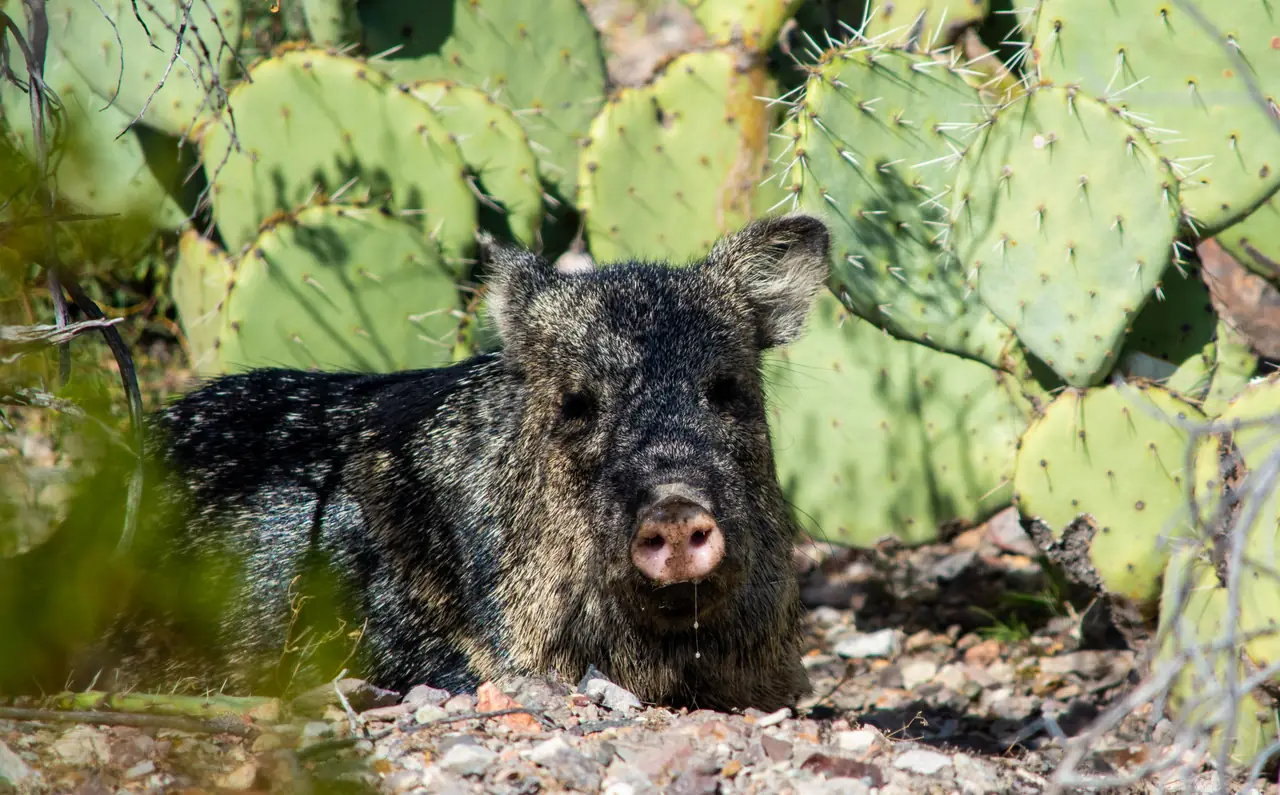
Photo: NPS · public domain
- Hunts this season
- 2
- Season
- 2026
Hunts in this unit by draw odds
- Overall draw rate
- The share of applicants the agency's report counts who drew the hunt: every choice it prints applicants for, first choices only, or authorized permits per first and second choices, as the row says. It is not your chance of drawing.
| Hunt | GMUs | Overall draw rate | Filled their tag | Opportunity | Year |
|---|---|---|---|---|---|
| JAV-1-102 | 192324252627 | about 4 in 10 drew, 44% | — | — | 2026 |
| JAV-2-101 | 192324252627 | about 3 in 10 drew, 32% | — | — | 2026 |
Unit 23 — New Mexico
Game Management Unit 23 sits in far southwestern New Mexico, against the Arizona line. The Department of Game and Fish describes its boundary as beginning at the intersection of US 180 and the New Mexico–Arizona state line west of Luna, running south along the state line to US 70, southeast along US 70 to its junction with US 180 at Deming, then northwest along US 180 back to the state line — a three-sided unit whose western edge is the Arizona border and whose corners are the US 180 crossing of the state line west of Luna, the US 70 crossing of the state line near Virden, and the highway junction at Deming. The US 180 leg passes Silver City along the unit's northeastern edge, and the department's map shows the Gila River crossing the unit's western reaches near Virden.
The map also defines a named hunt area inside the unit: the Burro Mountain Hunt Area, which the department describes as the Big Burro Mountain portion of the Gila National Forest in GMU 23, including all private land within the National Forest boundary. For detailed navigation, the department's map references for the unit are the Gila National Forest map and the BLM's Deming, Lordsburg, Mogollon Mountains, Silver City and Tularosa Mountains quadrangles.
In land-ownership character, Unit 23 is predominantly public land with a meaningful private component; the public share is mostly national forest, state trust and BLM land, in that order of extent. That characterization comes from the USGS Protected Areas Database of the United States (PAD-US) 3.0 — the exact breakdown is in this page's land-ownership panel.
The hunts tabled on this page cover deer, elk and pronghorn every year, and javelina every year through two hunts shared with Units 19, 24, 25, 26 and 27. Bighorn sheep appears only through one hunt shared with Units 16B, 22, 24, 45, 49, 50, 53, 55 and 58 (6A and 6C were added in 2026), and only in the draw years whose data lists this unit for it — not 2024 or 2025, when the draw results name no unit for that hunt. New Mexico's draw is purely random: applications are randomly assigned sequence numbers, and the draw works through them in that order, trying each application's hunt choices in turn; the state grants no preference to applicants unsuccessful in previous drawings. Licenses in each hunt are split by quota — a minimum of 84 percent to New Mexico residents, 10 percent to applicants who have contracted with an outfitter and 6 percent to non-outfitted nonresidents — which is why the odds here are broken out by residency class. Treat any odds or opportunity score beside this text as a published rate from past seasons, or a score computed from two of them, not a guarantee.
Every draw-rate, success-rate and opportunity-score figure here is read from published reports — a guide to relative opportunity, never a guarantee of a tag or a harvest. Figures cover seasons through 2026; data last refreshed Nov 3, 2026. Source: New Mexico Department of Wildlife. Odds & Antlers is an independent product, not affiliated with or endorsed by it.